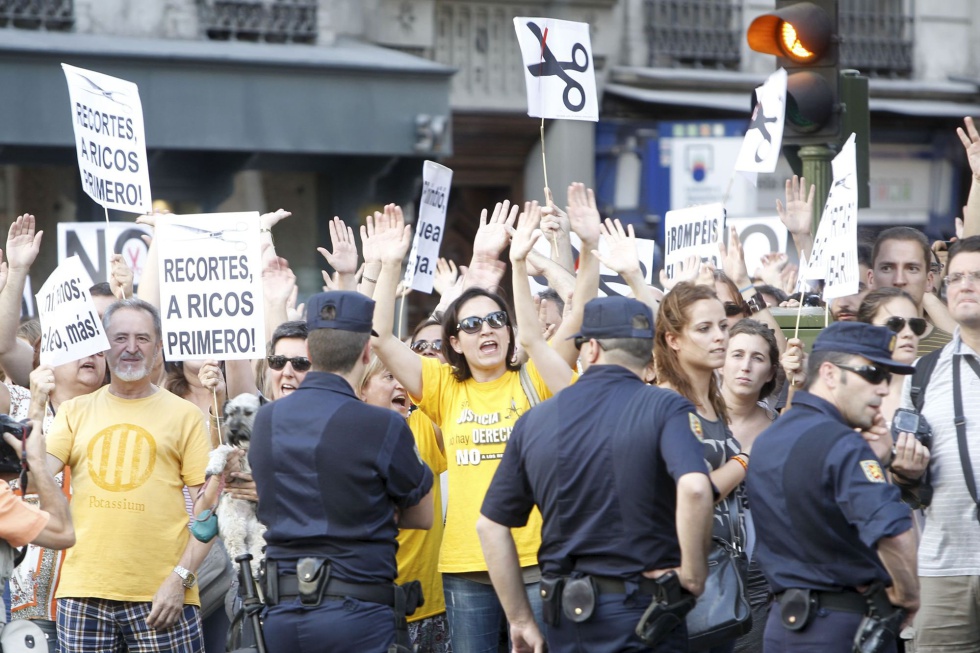
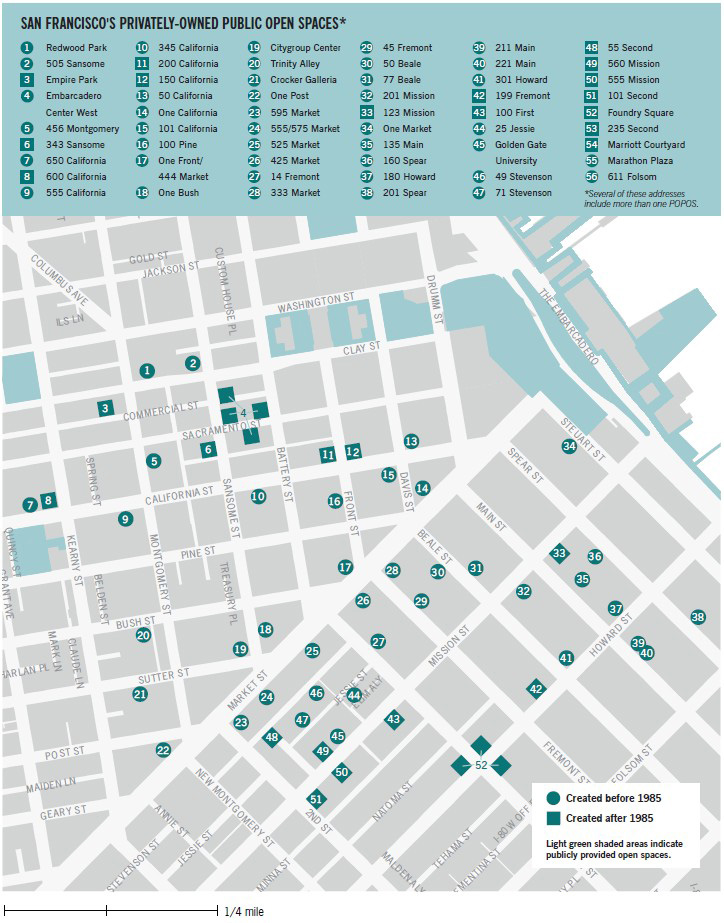
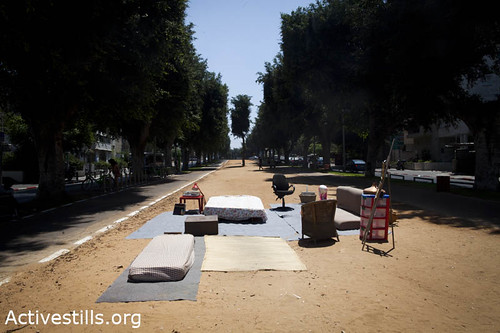
A discussion of the struggles, exoduses, and reappropriations of cognitive labor, especially in the field of visual art, and especially when taken as the leading edge of the “creative class,” while critically important, is trumped by the widespread, even worldwide, public demonstrations and occupations of the past year, this year, and maybe the next. I would like to revisit the creative-class thesis I have explored here in a recent series of essays in order to frame my remarks in light of these occupations, and to make a few observations about the relationship between artists, the positioning of the creative class, and the Occupy movement.1
Even before “the multitude” became a common touchstone for dreams of revolution, there was, famously, Seattle 1999, when anti-corporate protests brought environmentalists and community activists together with organized labor to block a meeting of the World Trade Organization, a scenario repeated at multiple locations in several countries in the years since.2 It is not news that the processes that go under the name of globalization, which center on the flows of capital, goods, and labor, create a unity that does not always serve the interests of capital or the capitalists.
 |
| Occupy Wall Street, New York, October 2011.e-flux |
Nouriel Roubini, channeling Marx, wrote in “The Instability of Inequality” that “unregulated capitalism can lead to regular bouts of over-capacity, under-consumption, and the recurrence of destructive financial crises, fueled by credit bubbles and asset-price booms and busts.”3
Roubini is saying that capitalism tends toward catastrophic collapses—no news here. But the point is that neoliberalism and its rampant financialization have created a capitalism that eats its young. Roubini goes on to remind his readers that even before the Great Depression, the enlightened bourgeoisie realized that worker protections and a redistributive system providing “public goods—education, health care, and a social safety net” were necessary to prevent revolution.4
Roubini remarks further that the modern welfare state grew out of a post-Depression need for macroeconomic stabilization, which required “the maintenance of a large middle class, widening the provision of public goods through progressive taxation, and fostering economic opportunity for all”; but all this went under during the massive Reagan-Thatcher deregulation, which Roubini—no Marxist after all—traces in part to “the flaws in Europe’s social-welfare model … reflected in yawning fiscal deficits, regulatory overkill, and a lack of economic dynamism.”5
Roubini, unlike most, goes on to proclaim the failure of this “Anglo-American economic model” of embracing economic policies that increase inequality and create a gap between incomes and aspirations, accompanied by the liberalization of consumer credit and thus rising consumer debt, as well as public debt because of decreased tax revenues, all of which is then followed by counterproductive austerity measures. This is precisely the financial model that seized the imagination and drove the policies of former Eastern bloc governing elites, many of whom in implementing the prescribed austerity measures, are destroying their present and future middle classes (see Latvia),6 as is neo-Thatcherite Great Britain.7
In the United States, Citibank, which required two US government rescues after the financial crisis of 2008, posted record quarterly profits of $3.8 billion dollars in the fall of 2011, a 74% increase over the previous quarter, while its CEO, Vikram Pandit, expressed his sympathy with the Occupy Wall Street protesters and offered to meet with them.8
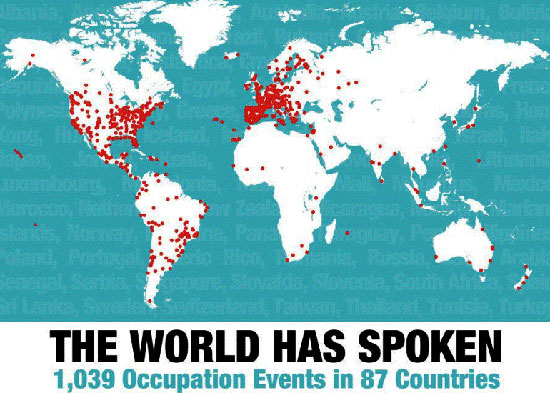
The ongoing round-the-world occupations, which have drawn inspiration from the uprisings across the Arab world in 2011, are driven by the frustration of the young educated middle classes—in the Arab case fairly new ones—confronting societies controlled by hugely rich ruling elites but having little hope of a secure future for themselves, despite their university educations. These are societies that had made no effort to create modern welfare or even neoliberal states, nor to control corruption, bureaucratic indifference, and flagrant nepotism, nor to institute more than the appearance of democratic governance. Protesters in the developed world are aware of sharing conditions that are functionally quite similar.9
Such protests—as in France in 2006, which saw widespread mobilization against “precarization” (alternatively, precaritization), as well as the subsequent uprisings in the Paris banlieues or in England in August 2011—also reflect the anger of working-class youths, especially their rage against racist police violence. In the English case, these young people were out there smashing and looting together with young members of the middle class. Some of the latter group had mobilized months earlier—as young Chileans are doing still—thanks in no small part to crushing increases in school fees driven by the Tory/Liberal Democrat governing coalition. The protests of these groups, these classes, have been fired by the recognition that there are likely no secure jobs for them, or perhaps any employment at all.
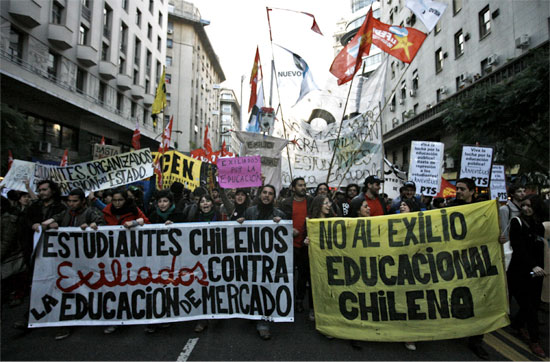 |
| Argentine and Chilean students march to the Chilean Consulate in Buenos Aires, on August 5, 2011, repudiating the police repression against Chilean students during demonstrations in Santiago de Chile. Copyright: Maxi Failla/AFP/Getty Images. In E-FLUX |
But precarization is not a necessary consequence of any particular form of labor.
Precarization now joins mechanization (the replacement of workers with machines), delocalization (capital’s worldwide search for the weakest labor and environmental regulations), and financialization (the maintenance of excess value in the stock market as opposed to surplus value extracted from manufacturing) as one of the great strategies used to restore profitability since the late 1960s. These strategies supplement the more widely noted assaults on the welfare state and worker’s rights.10 Many of the protesting students and young postgraduates, for their part, were preparing for jobs in what we have come to call the knowledge industries, or, more recently, the creative industries, a branch of the former.
1. University as Engine, Lifeways into Lifestyle
Let me step back a bit, to the consolidation of this sector in the newly dawning information age of the early 1960s. Clark Kerr, labor economist, first chancellor of the University of California’s elite Berkeley campus, and then president of the entire UC system, saw the university as a site for the production of knowledge workers. In 1960 he oversaw the creation of an expansive Master Plan for growth into the twenty-first century that harmonized the state’s higher education institutions and organized them into three tiers: research universities, state colleges, and two-year “junior colleges” (renamed “community colleges”). This “benchmark” plan acknowledged a need to unify the training and administration of the entire knowledge sector, from the elites to the working classes, in a politically divided world. Kerr called the university a “prime instrument of national purpose,” and he envisioned the “knowledge industry” (his term) as eventually supplanting the industries surrounding new modes of transportation—railroads in the nineteenth century and automobiles in the twentieth—in unifying the nation, acting as its economic masthead, and serving as the motor of US world dominance.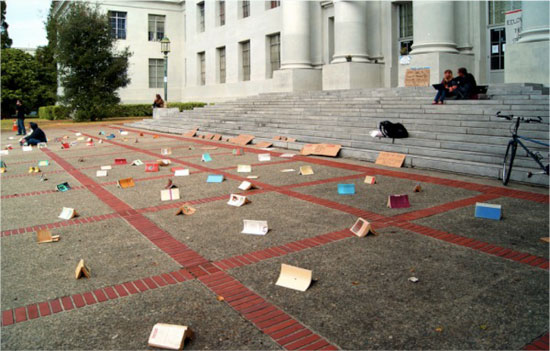 |
| Book-tents at Sproul Hall, at UC, Berkeley, after mandatory clearing of encampment, November 2011. |
The foundational student protest movement of the 1960s, Berkeley’s Free Speech Movement, was triggered in part by Kerr’s educational and managerial policies and goals. It was a movement of a leading sector of the middle class who were destined to become the elite workers of the new knowledge industries, if not their leaders. Ironically, today the UC system is almost broke, confirming the exemplary use of college campuses by Apple’s dictionary, in defining bellwether, that “college campuses are often the bellwether of change.”11
In contrast, the 1970s Britain punk subculture was arguably a working-class response to a diminished future, despite its partial traceability to art school, which in any case was a newly experimental repository for working-class misfits. As Dick Hebdige described it,
Despite the confident assurances of both labor and conservative politicians … that “we never had it so good,” class refused to disappear. The ways in which class was lived, however, the forms in which the experience of class found expression in culture, did change dramatically. The advent of the mass media, changes in the constitution of the family, in the organization of school and work, shifts in the relative status of work and leisure, all served to fragment and polarize the working-class community, producing a series of marginal discourses within the broad confines of class experience.12Punk was anti-commodity and anti-corporate, and followed a tactic of uglification and self-mutilation, a fuck you! response to bourgeois culture; the fact that it was quickly commodified and heavily promoted in the music industry is beside the point … until, at least, it became the point. For the post-1970s generations, lifestyle politics became almost indistinguishable from either politics or daily life, and that frame of reference has now spread around the world.
Indeed, lifestyle has been intensively developed as a major marketing point for consumer goods. In a prime nugget of lifestyle marketing analysis offered in 1984 (when the thinking was new), Theodore Levitt, Harvard professor of business administration and marketing, commented on the failure of the Hoover corporation to sell washing machines in Europe: “It asked people what features they wanted in a washing machine rather than what they wanted out of life.”13 Levitt, editor of the Harvard Business Review, is credited with popularizing the term “globalization.” In The Marketing Imagination, his bestseller of 1983, Levitt pointed out that as a result of media expansion worldwide, the United States was in a unique position to market its goods everywhere, making its so-called high touch goods—jeans and Coca-Cola—right up there alongside high tech ones (and integrally, along with them, Americanism and the English language) into the world’s most desirable possessions.
A powerful force drives the world toward a converging commonality, and that force is technology … Almost everyone everywhere wants all the things they have heard about, seen, or experienced via the new technologies.In short, without naming it but simply placing it under the rule of the “imagination,” Levitt defines the new key to marketing dominance as a wholesale subordination of rational product claims to universalized Bernaysian psychological modeling, which is the basis of lifestyle marketing. Levitt refers to homogenization as both the means and the result of globalization.14 He differentiates multinationals from the more forward-thinking global corporations, which, he says,
sell standardized products in the same way everywhere—autos, steel, chemicals, petroleum, cement, agricultural commodities and equipment, industrial and commercial construction, banking and insurance services, computers, semiconductors, transport, electronic instruments, pharmaceuticals, and telecommunications, to mention some of the obvious.Thirty years on, we have placed many of these categories in Levitt’s rather jumbled array under the rubric of the knowledge industries, including the management of Fordist industrial production (of “autos, steel, chemicals, petroleum, cement, agricultural commodities and equipment, … computers, semiconductors, … electronic instruments, pharmaceuticals”). Thirty years on, lifestyle politics, as both a unifier and a differentiator, help determine how we live or are supposed to live. People form alliances based on taste, above all via the tribalism of appearance-as-identity. Commodified lifestyle clusters include not merely possessions but persons, achievements, and children, and they tend to be costly to acquire and maintain. Punk is now another lifestyle choice, albeit an urban romantic one. Along with Goth and other ways of life associated with New York’s East Village, punk also provides the preferred uniform of suburban and small-town mall-dwelling malcontents, while the “Bronxish” hip-hop style, which is popular worldwide, does the same for working-class people of color. In this taxonomy, hipsterism is the lifestyle of arty types—the triumph of surface over substance—and is a direct consequence of the easy availability of cultural goods through technological means.
But there are times when the professionalization of art training in colleges and universities, combined with the capture and branding of artist-led, artist-run initiatives—the ones which used to reside outside the purview of art institutions—can broaden the social network and the vocabulary of action. It is a commonplace that in a post-industrial economy virtually all work falls in some sense under the reign of the language and symbolic behavior. Certainly, all cultural products are flattened into “information,” mashing together writing, research, entertainment, and, of course, art. The popular reception of art and its greatly expanded audience have allowed, in the present moment, a mutual visibility between artists and other underemployed groups, both educated and undereducated. Or perhaps more directly, looking for a series of master texts, the newly professionalized discourse of artistic production settled on Continental theories of aestheticized capital. How else to explain the peculiar position of artists at or near the vanguard of capitalist organization? Thus, even if the tendency may be toward the professionalization and embourgeoisement of artists, along with other members of the symbolic sector, when the future hits a brick wall, those ideas and alliances in potentia can have revolutionary consequences. The artists and artist-run groups, and others belonging to the creative-class demographic—which often overlaps with the group of those who identify as grass-roots activists, whether or not they have been to art school—have been at the center of instituting, strategizing, and energizing the Occupy Wall Street movement at New York’s Zuccotti Park—renamed Liberty Park.15
A way of life that relies on virtue and secular good living, as sold to a generation raised on school and media campaigns promoting civic responsibility and morality—such as Just say No to Drugs,16 Smoking Kills, and Save the Earth—is no doubt more likely to be adopted by urban art-school grads than any other demographic group. These are young urban professionals, perhaps, but not the “yuppies” of the past (though I am interested to see that the term has returned). The latter were high-earning lawyers, ad-agency honchos, and magazine editors, while these new young urban professionals are low-level workers and wannabes in their field. City life appeals to members of these industries, which themselves are made up of networks of small shops that benefit from face-to-face relations and the excitements of the urban environment.
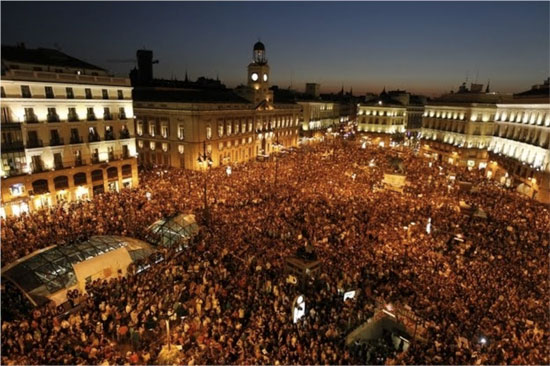 |
| Encampados (Indignados) Camp, Puerta del Sol, Madrid. Photo: Susana Vera/Reuters. In E-FLUX |
2. The New Creative City
This wave of renewed preference for the city can be traced to the postwar economic boom in Western industrial democracies—I am looking at the United States—which led to the rising affluence of the middle class. Immediately after the war, many city dwellers, having gained some measure of financial security, migrated to small towns and freshly built suburbs, causing urban shrinkage.17 One effect of this depopulation was the evacuation of many city business centers and the failure of many urban industries. But the direction of migration began to be reversed as bored children of the suburban middle class (along with corporate managers and the newly defined yuppies) were drawn to the organized pleasures of city life, not least the museums and theaters, as well as the dizzying mixture of anonymity, community, diversity, and possibility that fills the urban imaginary. To point out the obvious, the stultifying, homogeneous experience of life in the suburbs, with its identical malls and fast food joints, doesn’t offer the would-be creative much in the way of identity formation; and insofar as the local exists today, it is found either in the city or in rural small towns, not in fenced-in suburbia.This repopulation and transformation of cities—from spaces bereft of shops and manufacturing, starved of resources, and inhabited by poor and working-class people or squatters living in ill-maintained housing stock, into spaces of middle-class desire, high-end shopping, and entertainment—took at least a generation. It also required the concerted effort of city leaders. New York’s Soho and East Village had proved, by the late 1970s, that the transformation of old warehouses and decaying tenement districts into valuable real estate could be accomplished by allowing artists to live and work in them—if nothing else, city government recognized or identified with such people and understood their needs. Those elected officials who might, in an earlier era, have supported organized labor, found that such constituencies were fading away. Artists, in addition, were not going to organize and make life difficult for city governments. In the following decades, the Soho model became paradigmatic for cities around the world. (Another popular tactic was to attract small new industrial shops, mostly high tech ones.) But no matter how much the arts (whether the performing arts or the institutionalized visual arts in museums) have been regarded in some cities as an economic motor, that remedy is not applicable everywhere, and not every city has proved to be a magnet for the arts. A new urban theory was required.18
The civic usefulness of educated but often economically marginal young people was first popularized by a young professor of urban planning at Carnegie-Mellon University in post-industrial Pittsburgh. What Professor Richard Florida saw around him in that declining city was neighborhoods made cozy and attractive by the efforts of recent grads, who were setting up coffee shops and small businesses in low-rent locations. The customer-friendly environment—friendly to middle-class customers—emphasized shared tastes passed down since the mid-1960s via schools, music, movies, and magazines, tastes that define a particular niche among the educated, professional middle class. Elements of what might ironically be seen as suburban virtue, from recycling to gardening to arts and crafts (perhaps rescued from the lore of small-town Edens by nostalgic lifestyle magazines), were now being brought back to decaying city neighborhoods.
Professor Florida developed a new theory based on selling these congeries of young, generally underemployed people—as well as such subcultural categories as gays, who also tended to congregate in what used to be called bohemian neighborhoods—to urban planners as a sure-fire remedy for urban desuetude. (Or apparently selling them, for there is a bait and switch tactic at work here.) His book The Rise of the Creative Class: And How It’s Transforming Work, Leisure, Community, and Everyday Life offered a crafty new turn in business evangelism, creating a catchy new way of thinking about city marketing as lifestyle marketing—much as Theodore Levitt had done for brand marketing—and throwing a lifeline to often desperate city managers.19 With his apparently systematic analyses, Florida parlayed his popular book into a new job and a consulting career. He is now the head of the Martin Prosperity Institute at the University of Toronto, and he is consultant to cities, corporations, museums, and nonprofits around the world. Prosperity, like the lovely name Florida, is a keyword. His website says,
The Creative Class Group is a boutique advisory services firm comprised of leading researchers, communication specialists, and business advisors. CCG combines a pioneering approach of global thought leadership and proven strategies offering clients worldwide the market intelligence critical for competitiveness and greater economic prosperity. 20I have addressed Florida’s “creative class” thesis in a series of earlier articles; here I offer an abbreviated digest, to flesh out the argument.21 There is a certain irony to revisiting this matter now, as the long-term financial downturn has cast some doubt on the appeal of creative-class theorizing in the areas under financial strain, but the thesis has had a decade to catch hold, and catch hold it has.22 Florida’s analyses have struck a chord with city managers by appearing to promote diversity in ways that often replicate what is already in place. Many who have scrutinized at his data have demonstrated the insufficiency of his analyses and thus his conclusions.23 Critics point out that in relying on standard census categories, he sweeps into the creative class all knowledge-industry workers, from those in call-centers to professional data analysts, scientists, and mathematicians—hardly artists.24 A consensus on his conclusions is that they amount to the well-established “human capital” thesis of urban development placed within new linguistic frames, and most importantly with the “creative” moniker generously washing over everyone in the knowledge industries. A small, relatively poor group of urban dwellers, the ones offering consumer friendliness and local color, becomes the face of the other, larger, richer, but basically invisible members of Florida’s “supercreative core” grouping.25 In his shell game, creatives are defined under one shell as people whose mental engagement is at the heart of their work and under another as people who know how to live nicely, decoratively, and cheaply, and under yet another as primarily a high-earning, tax-paying economic grouping. As policy follows prescriptions, inconvenient, poorly accoutered working-class people are marginalized, pushed further out to the edges of the city or to the suburbs, while in the newly reclaimed city precincts, bourgeois predilections—of ego-centered, commodified, and mediated rituals—enfold every milestone in life, from birth to premarital stag and hen parties, weddings, baby showers, births, communions, and maybe even deaths.
3. The Limits of Creativity, and of Liberalism
Many critics naively fail to realize that Florida, like Clark Kerr, is a social liberal. Like most neoliberals, he is out there on the rhetorical barricades arguing for tolerance, subsidies, and the right of the creative class to perform the work of the patrician class for little or no compensation. In a strange way, then, he can be taken as the collective projection of a certain branch of the liberal elite. Liberals are happy to celebrate artists, or even better, “creatives”—that amorphous group of brewers, bakers, urban farmers, and baristas—as long as their festivals and celebrations can be sponsored by banks, corporations, and foundations and their efforts civically branded. Architectural institutes hold meetings and publish newsletters touting “livable” cities. Arts institutions benefit from the attention of governmental agencies and foundations, but the costs are also worth considering.Artists, already complicit (wittingly or unwittingly) in the renegotiation of urban meaning for elites, were called upon to enter into social management. Real-estate concessions have long been extended to artists and small nonprofits in the hopes of improving the attractiveness of “up-and-coming” neighborhoods and bringing them back onto the high-end rent rolls. The prominence of art and “artiness” allows museums and architecture groups, as well as artists’ groups, artists, and arts administrators of small nonprofits, to insert themselves into the conversation on civic trendiness.
Artists are hardly unaware of their positioning by urban elites, from the municipal and real estate interests to the high-end collectors and museum trustees. Ironically, perhaps, this is also the moment in which social engagement on the part of artists is an increasingly viable modality within the art world. and young curators specialize in social practice projects. Many artists have gone to school in the hopes of gaining marketability and often thereby incurring a heavy debt burden. Schools have gradually become the managers and shapers of artistic development; on the one hand, they prepare artists to enter the art market, and on the other, through departments of “public practice” and “social practice,” they mold the disciplinary restrictions of an art that might be regarded as a minor government apparatus. These programs are secular seminaries of “new forms of activism, community-based practice, alternative organization, and participatory leadership in the arts” that explore “the myriad links between art and society to examine the ways in which artists … engage with civic issues, articulate their voice in the public realm.”26
To look again at the United States—but not only there—arts and architecture institutions are quite pleased to be swept along by the creative-class urban-planning tide. The distinctly old-economy, luxury-vehicle maker BMW has joined with the Guggenheim Museum to create “a mobile laboratory traveling around the world to inspire innovative ideas for urban life,” with the names of some high-profile artist and architect attached.27 The “Lab” firmly ties the corporation, the museum, architecture, art, and entertainment to the embourgeoisement of cities.. Urban citizenship has replaced other forms of halo-polishing for so-called corporate citizens. By the way, they all like bikes. As does Urban Omnibus—which also likes “Art as urban activator.”
The Urban Omnibus is an online project of New York’s venerable Architectural League and is funded by foundations, the city of New York, and the federal government.28 Its recent feature, “Civic Action: A Vision for Long Island City,” describes a new venture, developed by two local contemporary art museums, that “invites artist-led teams to propose visions for the future of Long Island City,” a neighborhood in the borough of Queens, New York, that is a post-industrial ruin with new high-end waterfront residential development. Another feature, “Making Room,” is “a research, design, and advocacy project to shape New York’s housing stock to address the changing needs of how we live now.”29 As I write, in March 2012, there is a feature on the site in which a freelance writer describes an open house at the newly renovated jail, The Brooklyn House of Detention, an event designed to placate the neighborhood gentrifiers that all will be well.30 I am here using the Lab and Urban Omnibus to represent the myriad efforts of city agencies and elite institutions—and some free-standing ones or those attached to public universities that still follow a noncorporatized path, to adopt the now virtually naturalized creativity and hipster-friendly memes posed in terms of imagination, design, and advocacy, just as in some respects I am using the name Florida to represent the creative-class thesis that his work has helped turn into dominant policy lingo.
The Florida version of the Soho urban transformation model, as I have argued, fails to capture the agency of the actors in his transformational scenarios. Just as science has been seen in the capitalist mind as a necessary steppingstone to technology (a business term), creativity is regarded as the necessary ingredient of “innovation.” The creative classes as constructed by Florida operate strictly within the world view pictured by the capitalist imaginary; even those who are not simply employees in high tech firms are seen to be instituting small businesses and learning to deliver retro boutique services that bear echoes of prewar American neighborhood shops and delicatessens or even nineteenth-century “purveyors” (next up, the milk wagon and the seltzer-delivery man!) or idealized French or Italian shops in cities and villages. They have no agency outside the application of their imaginative abilities to the benefit for the gentrifiers and the well-to-do. They have no agency in respect to large-scale political and social transformation. It is true that the Florida model is not strictly interested in those whom the present readership recognize as artists. But here the picture of agency is even worse in respect to the market artists whose potential social worth is quite directly to serve the interests of the international clientele inhabiting the most rarefied income heights, a service role to which a generation or two of artists have been trained to aspire.
 |
| Book Bloc, Occupy Oakland. iN E-FLUX |
But this is not the picture of ourselves that most of us artists, curators, critics, wish to recognize. Like other participants in the movements taking place around the world, and like participants in earlier ones, artists tend to want to lend themselves and their energy and abilities to social betterment and utopian dreaming, but not necessarily as participants within the sanctioned institutionalized frames. The artistic imagination continues to dream of historical agency. In a protracted economic downturn such as we are experiencing now, while the creative-class thesis is showing its limits in respect to saving cities, it becomes clearer that artists and other members of the art community belong to the pan- or non-national class whose composition is forged across boundaries and whose members are inclined, as the cliché demands, to think globally and act locally.
Political movements are perpetually dogged by accusations of 1960s nostalgia and even Luddism, a result of the antimodernism of much 60s counterculture. People on the left are routinely derided by the Right as dirty fucking hippies, and once the occupations began, the Right was not slow to use this picture to discredit the occupiers. But the constellations of dissent have largely changed since the 1960s. If people are aiming to secede from modernity, they do so with a different range of continental theorists to draw upon, and without the three-worlds model of political contestation, in which the land-bound peasant figured strongly as an ideal, or the tribal nomad for those not inclined to socialist revolution. Revolution now looks more anarcho-syndicalist, or perhaps council communist, than Marxist-Leninist. The city is not simply the terrain to be evacuated, nor is it the site of guerrilla warfare; it is a conceptual puzzle as well as a battleground in which the stakes are slow-motion class war, and farming is brought to the city not by dreamers in homespun clothing but by those who might adopt the garb of the professional landscape architect or beekeeper. “Creatives” may bring not only a training in design and branding, and often a knowledge of historical agitprop and street performance, but also the ability to work with technological tools in researching, strategizing, and implementing actions in virtual as well as physical spaces. Actually or functionally middle-class, they are at ease with the discourses and modes of intellectual endeavor required in higher education, or in college prep. Craft and skill are enfolded in a framework that differs significantly from their earlier understanding; but the hegemonic role of the knowledge industries and the “devices” of electronic production and communication render that framework near-ubiquitous.31 The often flexible schedules of artists and other members of the precarious sectors of Florida’s creative/bohemian classes also permits a freedom to come and go at encampments and meetings, an ability to shift time and work commitments that is not available to all.
We can see the occupation activists as staking a claim, creating a presence, setting up a new public sphere, demanding the reinstatement of politics by refusing to simply present demands to representative governments and instead enacting democracy themselves. (Democracy has long been part of the American particular brand, albeit usually combined with double-barreled neoliberalism—or neoimperialism.) While welcoming the new, I can’t resist pointing back to the old, not to the eighteenth-century demands for self-governance led by a group of bourgeois colonial rebels in the American colonies but to the American Civil Rights Movement and one of its children, the Free Speech-inspired, anti-war, worldwide student movement of the 1960s, for which democracy—direct democracy, without representation—was a foundational idea, at least as the degree zero of the movement in the early years.32 In this current iteration, the contributions of celebrity artists such as Shepard Fairey (made famous by his Obama/Hope campaign poster of 2008) have been politely greeted but are beside the point, as it is not hard to see the occupations themselves as grand public works of process art with a cast of several thousand.33 The vast majority of artists—forming the core of the underpaid, unpaid urban army whose activities Florida acolytes wish to harness—live in a state of precarity that may lead them to seek social solutions in new and unexpected ways. This is where the so-called artistic mode of production comes in.
Urban sociologist Sharon Zukin, writing in 1982, identifies this precariousness of bohemian life as one of the five major ways in which this artistic mode of production affects the urban environment. The others include the “manipulation of urban forms [and] the transfer of urban space from the old world of industry to the ‘new’ world of finance, or from the realm of productive economic activity to that of nonproductive economic activity”; diminishing expectations about the provision of housing resulting from the substitution of “bohemian” living arrangements for contemporary housing; and, finally, the ideological function:
While blue-collar labor recedes from the heart of the financial city, an image is created that the city’s economy has arrived at a post-industrial plateau. At the very least, this displaces the issues of industrial labor relations to another terrain.34If the creative-class thesis can be seen as something of a hymn to the perceived harmony between the “creatives” and the financiers, together with city leaders and real-estate interests, guiding the city into the post-industrial condition, perhaps the current grass-roots occupations can be seen as the eruption of a new set of issues related to a new set of social relations of production. The mode of production, we remember, includes the forces of production but also their relations, and when these two come into conflict, a crisis is born. If the creative-class thesis can been seen as something of a hymn to the harmony between the creative forces of production and the urban social relations that would use them to the benefit of cities bereft of industrial capital, perhaps the current grassroots occupations can be seen as the inevitable arrival of the conflict between the creatives and the city that uses them. It is interesting, in this respect, that the battle cry has been “Occupy” (which echoes Florida’s similar injunction to gentrify), that is, to occupy space, to occupy the social and political imagination, in a way analogous to the way previous movements radicalized freedom into emancipation, republic into democracy, and equality into justice. Florida says gentrify, we say Occupy.
That leads us to the next step, now under way. What the occupations have done is to make members of disparate groups—neighborhood advocacy groups, immigrants’-rights groups, and working-class labor groups, both organized and not, visible to each other— and in Occupy’s first phase put them into temporary alliances. It is these alliances that form the nuclei of the occupation of the present and future.
This essay is an expanded version of a paper given at “Labour of the Multitude? The Political Economy of Social Creativity,” a conference organized by the Free/Slow University of Warsaw and held at the University of Warsaw on October 20-22, 2011, just over a month after the Occupy movement began. The essay has benefited greatly from Stephen Squibb’s comments and discussions.
© 2012 e-flux and the author
NOTAS
1 See Martha Rosler, “Culture Class: Art, Creativity, Urbanism” in e-flux journal 21 (December 2010, part I): →; (February 2011, part II):→; 35 (July 2012, part III): →. 2 The movement generally pegged as anti-globalization is more properly referred to by its members and supporters as the “alt-globalization” movement or some variant of that term and is anti-corporate more than anti-globalization—although globalization is a term derived from its enthusiasts; see the discussion of Theodore Levitt below.
3 See → and →. Roubini begins this blog post of October 14, 2011, by alluding to “social and political turmoil and instability throughout the world, with masses of people in the real and virtual streets”: “the Arab Spring; riots in London; Israel’s middle-class protests against high housing prices and an inflationary squeeze on living standards; protesting Chilean students; the destruction in Germany of the expensive cars of ‘fat cats’; India’s movement against corruption; mounting unhappiness with corruption and inequality in China; and now the ‘Occupy Wall Street’ movement in New York and across the United States.”
4 I addressed this issue in an essay of 1981 on documentary photography (“in, around, and afterthoughts: on documentary photography”). I was pointing out that ideological images were employed in the United States, during the Great Depression, to mobilize support for the very poor under the Roosevelt Administration, with the understanding that alleviating suffering would forestall revolt.
5 Roubini, ibid. I am using Roubini here as a convenient figure, since one might quote from quite a few other economists, particularly Joseph Stiglitz, Dean Baker, and Paul Krugman of the New York Times, or Simon Johnson, former chief economist of the IMF, to outline the fears of the left-liberal wing of Western economists.
6 Latvia, a tiny Baltic country that (like the other two Baltic states, Estonia and Lithuania) broke free of the collapsing Soviet Union in the early 1990s, is so far the sharpest example of this syndrome; one might also cite Ireland and possibly Greece, Spain, and Portugal in the coming year— all of which stand in contrast to the course of Iceland (the tiniest economy of all of these, but, as luck would have it,not a member of the Eurozone), which was promptly to reject any terms imposed by international financial agencies and instead defaulting on its debt and pursuing their top bankers for criminal fraud. In the early 2000s, Latvia’s center right government instituted aggressive neoliberal measures in large part to join the euro and escape the dominance of Russia. After the financial crisis of 2008—, Latvia experienced the most precipitous financial decline of any nation, losing about a quarter of its GDP in 2 years. Its government then applied stringent fiscal austerity, including slashing pensions and wages. The budding middle class, in a familiar story, had been induced to buy homes on cheap credit, but this mortgage debt (owed largely to Swedish and German banks) cannot be repaid, while property values have also plunged. The austerity measures have failed to improve Latvia’s balance sheets but has sent the middle class, not to mention the poor, into subsistence mode—or emigration. Tens of thousands of Latvians have left, and unemployment stands at or above 20 percent. A reference from 2010 is →, and from 2011: →. Yet, like Ireland, Latvia is bizarrely hailed as a successful example of austerity budgeting. (Krugman writes: “A few more successes like this and Latvia will be back in the Stone Age.”)
7 The European Commission in 2011 voted in “the six pack,” a group of measures that overrides member states’s abilities to control their budgets, reinstituting the Maastricht Treaty’s limit of 3% on deficits and 60% of GDP on debts, beyond which large fines will be levied, among other penalties. According to economist Susan George, the Commission is also engineering a shift in worker protection leading to longer work weeks, lower pay, and later retirement. See Susan George, “A Coup in the European Union?,” CounterPunch, Oct. 14, 2011, →.The still-developing situation in regard to Greece (which will have EC monitors in place enforcing austerity measures) shows the anti-labor direction, a hallmark of neoliberalism, of the European financial governors.
8 See → and → and for JPMorgan Chase’s CEO Jamie Dimon, making essentially the same point, see →
9 Although Western European protests in response to the prospectless future, such as the indignados or encampados in Spain and the many demonstrations in Greece’s Syntagma Square, were critical examples, and the uprising in Tunisia was ultimately at least a partially successful one, the sheer scale and unlikely success (similarly only partial) of the occupation in Cairo’s Tahrir Square made it the touchstone for the movement, and it remains so regardless of its as-yet unfulfilled aims, In recognition of its role, veteran occupiers of Tahrir Square sent a message to Occupy Wall Street: “The current crisis in America and western Europe has begun to bring this reality home to you as well: that as things stand we will all work ourselves raw, our backs broken by personal debt and public austerity. Not content with carving out the remnants of the public sphere and the welfare state, capitalism and the austerity state now even attack the private realm and people's right to decent dwelling as thousands of foreclosed-upon homeowners find themselves both homeless and indebted to the banks who have forced them on to the streets. So we stand with not just in your attempts to bring down the old but to experiment with the new. We are not protesting. Who is there to protest to? What could we ask them for that they could grant? We are occupying. We are reclaiming those same spaces of public practice that have been commodified, privatized and locked into the hands of faceless bureaucracy, real estate portfolios and police ‘protection’. Hold on to these spaces, nurture them and let the boundaries of your occupations grow. After all, who built these parks, these plazas, these buildings? Whose labor made them real and livable? Why should it seem so natural that they should be withheld from us, policed and disciplined? Reclaiming these spaces and managing them justly and collectively is proof enough of our legitimacy.” See →.
10 See Christian Marazzi, The Violence of Financial Capital, trans. Kristina Lebedeva and James Francis McGimsey (Los Angeles: Semiotexte, 2011).
11 The New Oxford American Dictionary has since 2005 come installed on Apple computers using version OS X.
12 Dick Hebdige, Subculture: The Meaning of Style (London: Methuen, 1979), 78.
13 Levitt writes, in distinguishing what he considers a multinational mind set from a global one, “The Hoover case illustrates how the perverse practice of the marketing concept and the absence of any kind of marketing imagination let multinational attitudes survive when customers actually want the benefits of global standardization. The whole project got off on the wrong foot. It asked people what features they wanted in a washing machine rather than what they wanted out of life. Selling a line of products individually tailored to each nation is thoughtless. Managers who took pride in practising the marketing concept to the fullest did not, in fact, practise it at all. Hoover asked the wrong questions, then applied neither thought nor imagination to the answers.” Theodore Levitt, “The Globalization of Markets,” The McKinsey Quarterly (Summer 1984): 13.
14 In the homogenizing world market, certain goods, such as pizza, tacos, and bagels, become near-universal signifiers of difference.
15 The Wall Street occupation was set in motion by a number of events, which I can only partly sketch out here. The occupation had been foreshadowed a couple of months earlier by Bloombergville, a three-week encampment of labor leaders and grass-roots activists held at City Hall Park against draconian budget cuts and named after the mayor of New York. (Another important precedent: the weeks-long occupation of the Wisconsin State House in Madison, supported by unions, including police unions). An article speculating on the possibility of emulating Tahrir Square by anarchist and anthropologist David Graeber was published byAdbusters, a Situationist-inspired, high-gloss Canadian magazine. Adbusterssubsequently put out a general call for a Wall Street occupation on September 17. Discussions about the possibility of building a movement had been held over the summer at 16Beaver, an artist-run discursive space in the Wall Street area. An ad hoc meeting at 16Beaver, after a Debt/Commons seminar heavy with activists and academics at which Graeber discussed his work on debt (Debt: The First 5,000 Years, New York, Melville House, 2011), was the final impetus toward the occupation centering on a General Assembly. The Bloombergville group put together the Sept. 17th occupation, but Graeber, together with Japanese anarchist activist Sabu Kohso and anarchist artist and activist Georgia Sagri, whom he had encountered at the 16Beaver seminar, then organized the General Assembly along anarchist lines.
In October 2011, Adbusters offered some further tactical advice that was more artworld than old-school activist, but still familiar since the anti-WTO protests in Seattle, if not since the days of Yippie in the late 1960s or even the prewar Dada performances: “It’s now time to amp up the edgy theatrics … deviant pranks, subversive performances, and playful détournements of all kinds. Open your insurrectionary imagination. Anything, from a bottom-up transformation of the global economy to changing the way we eat, the way we get around, the way we live, love and communicate … be the spark that sustains a global revolution of everyday life!” The Performance Studies Department of New York University soon after began hosting a weekly series of lectures and workshops focusing on social change through “creative tactics and strategies.”
16 Drugs, that is, not considered part of the approved Big Pharma formulary. This is important because among other things it allowed adolescents to make distinctions between good and bad drugs, but often based on criteria other than legality.
17 Since racism was an important motivator, the resulting urban shrinkage is often attributed in no small part to “white flight.” Small towns often became dormitory towns for city workers. The small town has remained the preferred location of US residents for most of its history and was idealized during the high point of American sociology that spanned the Second World War.
18 Although the demonization of working-class and poor residents in areas ripe for real-estate harvesting is a tactic of long standing, the in-coming “good people” have only recently been granted a profile of their own; previously, class privilege was taken for granted as a deserved entitlement.
19 Richard Florida, The Rise of the Creative Class: And How It’s Transforming Work, Leisure, Community, and Everyday Life (New York: Basic Books, 2003). Florida did not come up with the idea of the creative class, but he did populate it with statistical categories. According to his thesis, the creative class makes up about 30 percent of U.S. workers, but as we shall see, the groupings he uses are problematic.
20 See →.
21 See note 1.
22 Toronto, Florida’s base, is currently afflicted by a mayor with a take-no-prisoners, right-wing populist style, complete with racist and anti-gay pronouncements and actions. In repudating the previous government’s agenda, Ford has cut funding for bike lanes and light rail. Asked about Florida’s response, Torontonians with whom I spoke said that he has been largely quiet but had complained that the city was cutting all the things that made Toronto “his city.”
23 Recently Florida has been criticized again for sloppy interpretation and aggregation of polling data and economic statistics in his article “Why America Keeps Getting More Conservative,” published in the venerable magazine The Atlantic (these days politically center-right), where he is one of 19 editors. See →.” Many other commentators read the data quite the opposite way and claim that the US electorate is, on the contrary, growing increasingly liberal in its beliefs while US politics, thanks to the radicalization of the Republican Party, have moved to the right. See, for example, → and→.
24 Florida ingeniously includes in his mix a statistically small bohemian group, which includes gay people, but as Harvard economist Edward Glaeser has reluctantly noted, his data regressions suggest that in only two cities—in, yes, the state of Florida—does the gay population help the economy.
25 [T]o harness creativity for economic ends, you need to harness creativity in all its forms. You can’t just generate a tech economy or information economy or knowledge economy; you have to harness the multidimensional aspects of creativity. … there are three types of creativity: technological creativity…; economic creativity, … turning those things into new businesses and new industries; and cultural and artistic creativity, … new ways of thinking about things, new art forms, new designs, new photos, new concepts. Those three things have to come together to spur economic growth.
The creative class is composed of two dimensions. There is the supercreative core, … scientists, engineers, tech people, artists, entertainers, musicians—so-called bohemians that are about 12 percent of the workforce … the supercreative core is really the driving force in economic growth. In addition to the supercreative core, I include creative professionals and managers, lawyers, financial people, healthcare people, technicians, who also use their ideas and knowledge and creativity in their work. I don’t include people in service or manufacturing industries who use creativity in their work.
Christopher Dreher, interview with Richard Florida, Salon,June 7, 2002. →
26 These quotes are from a job announcement put out by a department at a major university that offers “a Master’s Degree in Arts Politics which treats, in an activist key, the nexus between the politics that art makes and the politics that make art.” Despite my skepticism, I don’t want to dismiss the potential of such training and network formation; the problem lies in the short life span that such initiatives can have before the institution render them zombies. See the latter two installments of my Culture Class essay (→, →) for a discussion of the culturalization argument of Fredric Jameson and its adoption by George Yúdice to argue that art that can be framed as social practice may put the artists in the position of unwittingly serving the aims of the state and, by focusing on melioration, of abandoning the possibility of critique.See also footnote 4, above.
27 See →. There was an unsuccessful effort by artists to occupy the lab during a day of artists’s actions.
28 See →. Urban Omnibus is funded by the Rockefeller Foundation’s New York City Cultural Innovation Fund, the National Endowment for the Arts, the New York City Department of Cultural Affairs, and the New York City Council. The Architectural League was founded in 1881 by Cass Gilbert and has long sought to recognize the importance of the arts in relation to architecture.
29 The phrase “how we live now” evidences a predictable set of assumptions about who constitutes the “we.” As I write, in March 2012, there is a feature on the site in which a freelance writer describes an Open House at the newly renovated Brooklyn House of Detention, designed to placate the neighborhood gentrifiers that all will be well. See →.
30 See →.
31 The most prominent sign of technological sophistication is the frequent visual reference to Anonymous, an amorphous group of hackers, or hacktivists (of which one small international groupuscule, LulzSec, was arrested in February 2012), in the form of the Guy Fawkes masks from the V for Vendetta franchise (worn by protesters and occupiers and used on signage). "Anonymous" apparently has carried out denial-of-service attacks against the websites of the governments of Tunisia, Egypt, and Bahrain during the attempted revolutions there, and it has expressed or enacted support for Occupy. See →.
I do not have the space here to dissect further the possible role of this pointedly anarchic, often playful, assemblage of hackers. But in more workaday fashion, a range of technological ease is suggested by the facility with which the Occupy movement has made use not only of the widely know popular media sites such as Facebook and Twitter but also of less well known ones, sites such as Vibe, the older IRC, the now indispensable Livestream, Reddit, or internet relay chat, according to PC magazine as well as Tumblr and Google docs. See, for example, →.
An early assessment:
"‘We set up shared google docs so we could communicate.…And we set up google voice numbers for everyone.’…One Tumblr page, ‘We Are The 99 Percent,’…reveals the plight of people, who see themselves as far outside the top 1 percent of Americans.” →.

32 Here I am looking not only to the town meetings of the early days of the American colonies but explicitly to the model of nonviolent participatory democracy propounded by one of the groups central to the Civil Rights Movement, the Student Nonviolent Coordinating Committee, or SNCC. Many of the young student activists had joined SNCC’s Freedom Rider campaign to disrupt racial segregation in the American South, which influenced the principles outlined shortly after in the Port Huron Statement, a foundational document of the student/antiwar movement. Naturally enough, the history, origins, and influences of these movements are more complex than I can sketch out here. The widely noted, galvanizing speech of Berkeley student leader Mario Savio, delivered in the Berkeley campus quadrangle on Dec. 2, 1964, during a stand off with university police, includes the following in its preamble:
I ask you to consider—if this is a firm, and if the Board of Regents are the Board of Directors, and if President Kerr in fact is the manager, then I tell you something—the faculty are a bunch of employees and we're the raw material! But we're a bunch of raw materials that don't mean to be—[to] have any process upon us. Don't mean to be made into any product! ... Don't mean to end up being bought by some clients of the University, be they the government, be they industry, be they organized labor, be they anyone! We're human beings!
33 Artists’s groups are increasingly making this point, for good or ill; see, for example, → and →.
34 Sharon Zukin, Loft Living, p. 180.
Martha Rosler is an
artist who works with multiple media, including photography, sculpture,
video, and installation. Her interests are centered on the public sphere
and landscapes of everyday life—actual and virtual—especially as they
affect women. Related projects focus on housing, on the one hand, and
systems of transportation, on the other. She has long produced works on
war and the “national security climate,” connecting everyday experiences
at home with the conduct of war abroad. Other works, from bus tours to
sculptural recreations of architectural details, are excavations of
history.